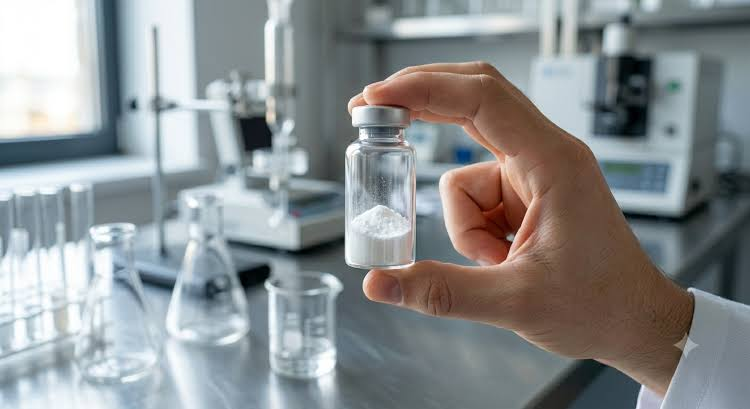
Every research peptide vendor claims high purity. Every single one. That’s not suspicious on its own; it’s just marketing. The real question is who checked that claim before it landed on the product page. And once you start looking closely, it becomes clear that third-party tested peptides aren’t just a nice bonus feature. They’re the one thing separating a real quality claim from a company’s own opinion of itself.
An In-House Test Isn’t Really a Test
Let’s break down the dilemma. If an ingredient supplier conducts its own purity tests and then prints its findings on its own certificate, it is nothing more than self-verifying its own actions. It is the same as someone doing the work and reporting a result that satisfies him/her. The third party has not been involved in any process.
This alteration in reality happens really often on the research peptide market, and most of the buyers are totally unaware of it. A certificate of analysis seems to look like an official document irrespective of who has been making it. There are numbers in percentages, presence of sometimes a chromatogram, and technical terms. From the visual perspective, the certificate provided by one’s own laboratory and by truly independent laboratory can seem absolutely identical. The only difference is whether you inquire from someone actually did the work in laboratory.
What Legitimate Peptide Testing Standards Actually Require
Solid peptide testing standards rest on two things working together, not one alone.
HPLC stands for high-performance liquid chromatography, used for measuring purity. It divides the sample and demonstrates the results in the form of a chromatogram with peaks. The peptide in question should present itself as dominant and perfectly visible in the form of one peak. All the other peaks surrounding the main peak are impurities accumulated over the period of synthesis. The size of the main peak in comparison to other peaks gives the purity percentage.
Mass spectrometry has different purposes. It determines the composition by measuring the actual molecular weight of the content in the vial and comparing it to the needed molecular weight. This procedure is more important than one would think. Although HPLC shows that the compound is pure with a percentage of 99%, it can be a completely different compound altogether. The presence of HPLC indicates the level of purity, but it gives no indication whatsoever of the nature of the compound. The aforementioned state of purity can be practically meaningless without being coupled with a mass spectrometer.
Both tests should be performed at independent laboratories, while using internal facilities would give you an idea of the evaluation given by a company, disguised under laboratory procedures.
Why Independence Isn’t Optional
The scale of the problem is what makes this non-negotiable rather than just a nice-to-have. An independent analysis of commercially available research peptides found that roughly 25% to 30% of samples from unverified suppliers fell short of their stated purity claims. That’s not a rounding error. That’s a meaningful share of the market selling something different from what the label promises.
For anyone doing actual research, that gap isn’t harmless. Contaminants and impurities can quietly distort results, especially in dose-response experiments where even a small unexpected substance can shift outcomes enough to throw off conclusions. A researcher working off an unverified purity claim isn’t just risking a wasted purchase. They’re risking data they can’t actually trust.
What Genuine Third-Party Verification Looks Like
Real independent testing has a few consistent features worth knowing. The lab running the analysis has no financial stake in the sale, so there’s no incentive to round numbers up. Reports typically include a batch-specific reference or lookup code, letting a buyer pull the original report directly from the lab’s own system rather than trusting a copy on the vendor’s website. And the documentation spells out its methods clearly, naming the testing method, the equipment parameters, and the specific lab that performed the work.
That last detail matters more than people realize. A COA that just states “98% purity” without naming a method or a lab is telling you almost nothing. A COA that names an independent lab, links to a verifiable report, and details both HPLC and mass spec results is giving you something you can actually check.
The Bottom Line
Purity percentages are easy to print and easy to trust at a glance, which is exactly why they get abused. The only real safeguard is independent confirmation, someone with no stake in the sale checking that the label matches what’s actually in the vial. Skip that step, and every other quality claim on the page is just a company’s word, dressed up to look like proof.
Disclaimer
This article is provided for general informational and educational purposes only and does not constitute medical, scientific, regulatory, or purchasing advice. The discussion of third-party testing, HPLC, mass spectrometry, Certificates of Analysis (COAs), purity claims, and peptide quality is intended to explain general research-quality considerations and should not be taken as a guarantee that any particular product or supplier is safe, accurate, or suitable for a specific research application. Testing practices and results can vary between laboratories, batches, analytical methods, and products. Any statistics or claims regarding supplier testing should be independently verified against reliable, current sources before being relied upon. Researchers should independently review batch-specific documentation, verify laboratory credentials, follow appropriate handling and storage procedures, and comply with all applicable laws, institutional requirements, and safety standards. Peptides discussed or linked in this article are intended for legitimate research purposes only and should not be used for human or veterinary consumption, diagnosis, or treatment.