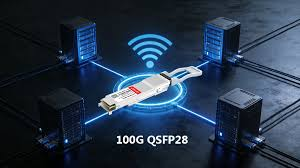
As data traffic continues to grow exponentially, modern data centers are under increasing pressure to deliver higher bandwidth, lower latency, and greater scalability. Data Center Interconnect (DCI) has become a critical component in ensuring seamless communication between geographically distributed facilities. In this context, 100G QSFP28 modules play a central role by enabling high-speed, reliable connectivity across different network layers. Among these, the LR4 variant stands out for its ability to support long-distance transmission over single-mode fiber, making it particularly suitable for interconnecting data centers.
The evolution of cloud computing, big data analytics, and distributed storage systems has further amplified the need for efficient DCI solutions. 100G QSFP28 modules provide a standardized and cost-effective way to scale network capacity while maintaining interoperability across different vendors and platforms. Specifically, the LR4 module, with its 10 km transmission capability, bridges the gap between short-reach intra-data-center links and long-haul optical transport systems.
In practical deployments, 100G QSFP28 modules are often selected based on distance requirements, fiber availability, and network architecture. While SR4 modules are commonly used for short-range connections within a single data center, LR4 modules are designed for longer distances, making them ideal for DCI scenarios such as campus interconnects, metro links, and disaster recovery networks. Understanding how LR4 modules are applied in these environments helps network designers build more efficient and future-ready infrastructures.
Understanding 100G QSFP28 LR4 Technology
Key Features of LR4 Modules
The 100G QSFP28 LR4 optical module is designed to transmit 100 Gigabit Ethernet signals over single-mode fiber using four separate wavelengths. Each wavelength carries 25 Gbps, and through wavelength division multiplexing, these signals are combined into a single fiber pair. This design enables transmission distances of up to 10 kilometers, making LR4 a practical solution for medium- to long-range connections in DCI environments.
In addition to its transmission capability, the LR4 module offers advantages such as compact form factor, standardized interface, and compatibility with a wide range of network equipment. Its ability to operate over duplex single-mode fiber also simplifies cabling compared to parallel optics solutions, reducing infrastructure complexity and improving deployment flexibility.
Core DCI Scenarios for 100G QSFP28 LR4
Interconnecting Data Centers Within a Campus
One of the most common applications of LR4 modules is connecting multiple data centers within the same campus or industrial park. These facilities are often separated by distances ranging from a few hundred meters to several kilometers, which falls well within the 10 km reach of LR4. By using LR4 modules, organizations can establish high-capacity links without the need for additional optical amplification or complex transport systems.
This type of deployment is particularly useful for enterprises that operate multiple buildings or for cloud providers with distributed infrastructure. The use of single-mode fiber ensures signal stability and minimizes attenuation, allowing consistent performance even as network traffic grows.
Metro Data Center Interconnects
In metropolitan areas, data centers are often located in different parts of a city to ensure redundancy, load balancing, and proximity to end users. LR4 modules enable direct connections between these facilities over distances of up to 10 km, making them a cost-effective alternative to more complex optical transport solutions.
By leveraging LR4 for metro DCI, network operators can achieve high-speed connectivity while avoiding the higher costs associated with long-haul optical systems. This approach is especially beneficial for service providers and enterprises looking to expand their network footprint within urban environments.
Disaster Recovery and Backup Networks
Another important application of LR4 modules in DCI is supporting disaster recovery (DR) and backup strategies. Organizations often maintain secondary data centers at a safe distance from their primary sites to ensure business continuity in case of failures or disasters. The 10 km reach of LR4 allows these backup sites to remain close enough for low-latency synchronization while still providing physical separation.
In such scenarios, LR4 modules enable real-time data replication and failover capabilities, ensuring minimal downtime and data loss. This makes them a key component in building resilient and reliable network infrastructures.
Advantages of Using LR4 in DCI
Cost-Effective Long-Reach Connectivity
Compared to deploying dedicated optical transport equipment, using QSFP28 LR4 modules provides a more straightforward and cost-effective solution for medium-distance interconnects. The ability to use standard Ethernet interfaces reduces the need for additional hardware, simplifying both deployment and maintenance.
Simplified Network Architecture
LR4 modules allow network designers to extend Layer 2 or Layer 3 networks across multiple locations without introducing unnecessary complexity. By maintaining a consistent Ethernet-based architecture, organizations can streamline operations and reduce the learning curve for network administrators.
High Bandwidth and Scalability
With 100 Gbps per link, LR4 modules provide ample bandwidth for modern DCI requirements. As demand continues to grow, multiple links can be aggregated to further increase capacity, ensuring that the network can scale alongside business needs.
Considerations and Limitations
Distance Constraints
While LR4 modules support up to 10 km, this may not be sufficient for certain long-haul DCI scenarios. In such cases, other solutions such as ER4 or coherent optics may be required. Therefore, accurate distance assessment is essential during the planning phase.
Power Consumption and Cost
Compared to short-range modules like SR4, LR4 modules typically consume more power and have a higher upfront cost. However, these factors are often offset by their extended reach and reduced need for additional infrastructure.
Fiber Infrastructure Requirements
LR4 modules require single-mode fiber, which may not be available in all environments. Organizations relying on multimode fiber may need to upgrade their cabling infrastructure to take full advantage of LR4 capabilities.
Conclusion
100G QSFP28 LR4 optical modules play a vital role in enabling efficient and scalable Data Center Interconnects. From campus-level connections to metro networks and disaster recovery systems, their ability to deliver high-speed transmission over distances of up to 10 km makes them an ideal choice for a wide range of DCI applications. While they may not be suitable for every scenario, their balance of performance, cost, and simplicity positions them as a key technology in modern network design. By carefully evaluating deployment requirements and infrastructure conditions, organizations can leverage LR4 modules to build robust and future-proof interconnect solutions.